



Is Drilling Countertop Holes that hard?
After working several years in the Granite Industry, Sam, a good friend and a very good customer, decided to start his own Granite Shop a couple of years ago. We have been guiding Sam through our experience in the Granite Fabrication Industry to make his business more profitable, thus allowing Sam to expand it.
We decided to share some of the guidance we provided him through a series of articles covering the whole Fabrication process, from the Templating to Installation. We have already covered the Handling of Slab Stones, the Cutting Process, the Edge Profile Fabrication, and the Polishing of Granite Edges. With this article, Drilling Countertop Holes, we conclude the series of Granite Fabrication Tools. Sam approached us, asking:
What is the best way to open countertop holes for sinks or vanities? Would it be better to do it in a Wet or Dry environment?
Many people see drilling countertop holes with apprehension. Many things can go wrong, and nobody wants to expose their valuable and hard-worked pieces to chipping, breaking, or damage.
However, Drilling Countertop Holes is not hard at all if you use the right tools and approach the task with care.
For now, let’s focus on Drilling Countertop Holes…
Drilling the Hole
The first step is to Open the Hole or Holes the Countertop or Vanity will need for allocating the Sinks. As you know, it can be done in a Dry or Wet environment. It is a choice of tastes and having the right tools for each one.
Let’s start considering Drilling Countertop Holes in a Dry environment, which appears to be the preferred method for the majority of our customers. Before anything, you need to create a guide for Cutting out the Hole.
For doing this, you might use a Paint Marker (the same we signaled in the Cutting Granite Slabs article), which is the Met-al Squeezing Paint Markers, for drawing the contour of the Sink or Vanity for which you will be opening the Hole or Holes. Every Sink or Vanity will come with a guide or blueprint to easily mark it on the Stone.
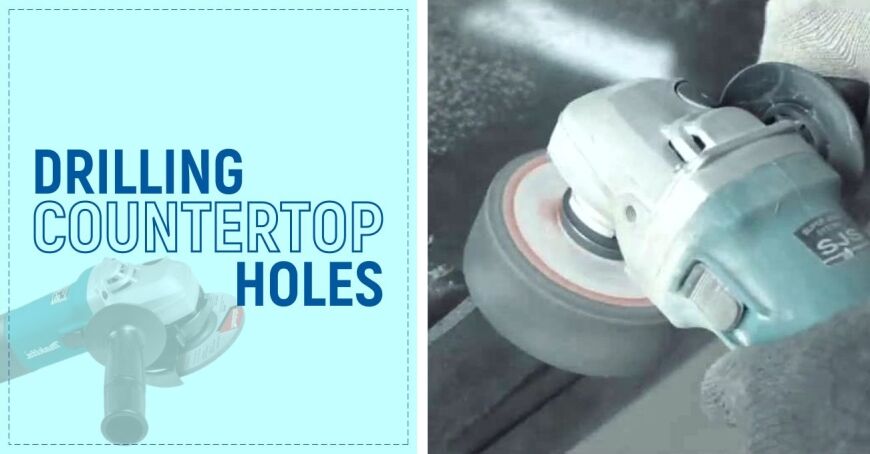
The Tool used for actually Drilling Countertop Holes that we recommend is the Makita Angle Grinder 9564CV, which is a very versatile and robust Angle Grinder. You will find other choices in the Variable Speed Grinders category.
Then, you will need a Blade. The preferred choice for this task is the Hurricane Contour Blades, designed for Cutting Curves, specifically designed for opening Sinks or Vanity holes. These are very long-lasting Blades, and their price is amazing for the quality they provide.
As with the Grinder, there are other choices for Contour Blades that you are free to explore. We’ve seen many of our customers try different options, and even though they agree that all provide good quality, most of them stick to the Hurricane Contour by Diamax.

If you prefer to do the Cutting in a Wet Environment, the Tools that need to be used are slightly different.
Depending on how your Granite Shop operates, you will be using an Electric Tool or a Pneumatic Tool, in which case you need to count with an Air Compressor, as discussed in Polishing Granite Edges.
If you are going to use an Electric Tool, we would recommend using the Alpha Wet Stone Cutter, which is very powerful and allows Curve Cutting in a very secure and professional way. Equipped with a powerful motor, this machine has proven to be an excellent choice to be used not only inside the Granite Shop but in the field too.
If you rather use a Pneumatic Tool, our recommendation goes to the Stone Pneumatic Wet Stone Cutter, another very powerful machine designed specifically for Wet Cutting, handling 5″ Blades and with a motor that goes up until 11,000 RPM.
With respect to the Blade to be used to do the Curve Cutting, Hurricane Contour Blades are the winner again. These blades are designed to do Both Dry and Wet Cutting, and, as mentioned earlier, provide nice Cuts.
Not only their Quality but an amazing price tag, make them the favorite of many Granite Fabricators.
Drilling Countertop Holes: Stock Removal
Once you finish Cutting with the Blade, you will end with a Rough Cut of the initial Template. Now is time to refine the process to obtain smooth Edges in the Hole. This is done usually with what is known as Zero Tolerance Wheels, part of the using Drum Wheels category.
Below are the most common Zero Tolerance Wheels, all of them proven to have excellent quality. You can choose the one which adapts better to your style of Fabrication.
- Wet Polishers By Diamax, Cup Wheels & Drum Wheels, Special Drum Wheels, Zero Tolerance & Drum Wheels By Diamax, Zero Tolerance Grinding Wheels
Cyclone Polishing Drum Wheels
 Wet Polishers By Diamax, Cup Wheels & Drum Wheels, Special Drum Wheels, Zero Tolerance & Drum Wheels By Diamax, Zero Tolerance Grinding Wheels
Cyclone Polishing Drum Wheels
- Edge polishing for sink cut-outs
- Recommended use: Oscillate up and down for proper even drum wear
- Rubber drum increases tread life & reduce vibration
- 5/8 – 11 female thread (M18 x 2)
- Special Drum Wheels, Zero Tolerance & Drum Wheels By Diamax
Cyclone Stock Removal Wheel
- Available in 36, 60, and 120 grit.
- Removes radius stock chip-free
- Zero Vibration
- Recommended use: Oscillate wheel up and down to wear evenly and avoid grooves
- Ideal for working with Engineered Stone and Granite
- ⅝” -11 thread
- Maximum 4,000 RPM
- Special Drum Wheels, Zero Tolerance & Drum Wheels By Diamax
Cyclone Vacuum Brazed Wheels
- Vacuum brazed, available in Coarse 30, Medium 50/60, and Fine 100 grits
- The fastest way to remove material after cutting out sink holes with a diamond blade, or to shape a radius on the outside edge.
- Ideal for working with Engineered Stone, Granite, Marble, and Ultra-compact.
- ⅝” -11 thread
- Maximum 3,000 – 4,000 RPM
- For Wet use only
-
- Zero Tolerance & Drum Wheels By Diamax
Cyclone Zero Tolerance Wheels
- Ideal for heavy stock removal and material clean-up. The aggressive multi-segment design increases life and performance.
- The most popular tool for truing vanity sink cut-outs
- ⅝” -11 thread with center water feed
- Available with resin to reduce vibration or segmented for aggressive stock removal
- Balanced to eliminate vibration
- Recommended use: Oscillate wheel up & down to wear evenly & avoid grooves
Edge Finishing
After working the radius of the recently opened Hole with the Zero Tolerance Drum Wheels, you need to finish the Edges.
Edge Finishing
After working the radius of the recently opened Hole with the Zero Tolerance Drum Wheels, you must finish the Edges.
This process is similar to the one explained in the Granite Edge Profile Fabrication when Edge Smoothing was discussed.
It uses Silicon Carbide Grinding Stones to prepare the inside radius to be Polished.
Depending on the roughness of the Edges, you might want to apply the following Grits to Finish the Edges in preparation for Polishing:
- Grit 46 (46G)
- Grit 60 (or 60G)
- Grit 120 (120G)
- Black Buff (Dark Stones) or White Buff (Clear Stones) when it’s necessary
Drilling Countertop Holes: Opening Faucet Holes
The last Step in the process consist of Opening the Holes for installing Faucets or any other thing that need to be installed on the Countertop or Vanity.
For doing that, a Core Drill Bit is used. Core & Non-Core Bits are Diamond Abrasives Drills designed specifically to remove a cylinder of material. Here are shown of the most popular ones.
We’ve arrived to the end of this article about Drilling Countertop Holes. I hope it has been helpful to you. If you subscribe to our newsletter below, you will get articles like this in your Inbox, together with our latest Offers and Coupons to our VIP Customers. Please keep reading to the conclusion.
I hope you enjoyed this article about Drilling Countertop Holes. Now, it is time to read your comments.
We invite you to express your opinion and let us know what practices you use for Drilling Countertop Holes, which tools do you prefer and if you dare, share your best secrets tips. We are sure it will help the entire community.


