



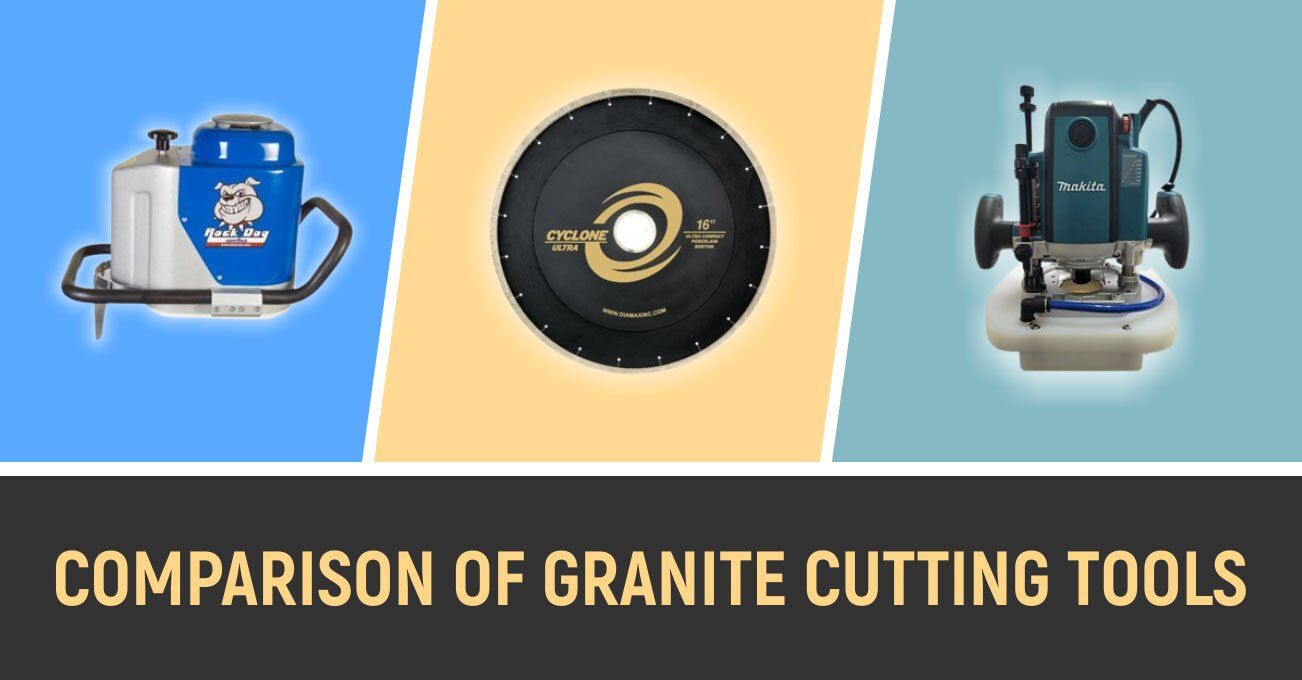
Granite Cutting Tools
Welcome to our comprehensive comparison of granite cutting tools. When working with granite and other hard materials, having the right tools is essential for achieving precision, durability, and efficiency in your projects. This article will explore various types of cutting tools available in the market and help you determine which is best for your specific needs. Choosing the right tool can be overwhelming, but don’t worry. We are here to guide you through the process. Let’s dive in and compare the options!
Granite Working Stages
Before starting our Comparison of granite cutting tools, let’s analyze the different fabrication stages. Transforming a raw granite slab into a finished product, such as a countertop, flooring tile, or decorative item, involves three essential stages: cutting, grinding, and polishing. Each stage requires specialized tools, and using the right ones can significantly impact the quality and efficiency of the process.
- Cutting and Shaping Granite Slabs: This initial stage involves using specialized tools like diamond saw blades, finger bits, router bits, or CNC finger bits to slice the granite into desired sizes and shapes. Precision is critical to ensure the final product fits the intended space and has a polished, professional appearance. Using high-quality cutting tools ensures clean cuts and minimizes the wastage of the valuable granite slab.
- Grinding: Grinding helps to level or flatten the granite’s surface, removing any unevenness or roughness. This step is often necessary to achieve a smooth base before polishing. Specialized grinding machines equipped with diamond abrasive discs are used to accomplish this. High-quality grinding tools are crucial for achieving a smooth and even finish without damaging the granite surface.
- Polishing: After cutting and grinding, polishing enhances the granite’s natural beauty and durability. Using progressively finer grits of polishing pads removes scratches or marks left from previous stages, creating a smooth, shiny surface. Quality polishing tools are essential for achieving a consistent and high-gloss finish, ensuring that the final product meets professional standards.
Investing in the best cutting, grinding, and polishing tools is crucial for achieving high-quality results. The right tools improve efficiency and reduce the risk of damage to expensive granite slabs. For professionals in the granite industry, this investment can lead to higher customer satisfaction, repeat business, and a more substantial reputation for delivering top-tier craftsmanship.
Types of Granite Cutting Tools
Selecting the right granite cutting tool is crucial for achieving clean, precise cuts and maximizing the lifespan of the tools and granite slabs. Below is a detailed look at the most common types of granite-cutting tools, including their advantages, drawbacks, and the applications for which they are best suited:
-
Diamond Blades
Diamond blades are the most commonly used tools for cutting granite because they can slice through hard materials precisely. They are made with a steel core and embedded diamond segments that grind through the stone. Diamond blades can be used with various machines, including angle grinders, bridges, and wet saws.
- Pros:
- High-cutting precision, suitable for detailed work.
- Versatile and can be used on different machines.
- Long-lasting when adequately maintained.
- Cons:
- Requires water cooling to prevent overheating and damage.
- Higher upfront cost compared to non-diamond alternatives.
- There is a need for proper handling to avoid chipping or damaging the stone.
- Pros:
-
Angle Grinders
Angle grinders are handheld tools that can be fitted with diamond blades, making them a versatile option for cutting, shaping, and finishing granite. They are ideal for smaller projects or making precise adjustments and detailed cuts.
- Pros:
- Portable and lightweight, allowing for flexibility on job sites.
- Suitable for intricate cutting tasks and edge work.
- It can be used for grinding and polishing with the right attachments.
- Cons:
- Not suitable for large slabs or extensive cutting jobs.
- Requires skill to control and avoid uneven cuts or damage to the granite.
- The dusty operation requires protective equipment and a well-ventilated workspace.
- Pros:
-
Stone Routers
Stone routers are powerful machines used to shape, profile, and polish the edges of granite, marble, and other types of natural stone. Typically fitted with diamond-tipped router bits, these routers can create smooth, decorative edge profiles on countertops, tabletops, and other stone surfaces. They come in handheld models and larger, more automated versions used in professional fabrication shops. Stone routers can produce a variety of edge styles, such as bullnose, ogee, beveled edges, and more, adding a refined finish to stone installations.
- Pros:
- Stone routers allow for precise control when shaping edges, making them ideal for achieving smooth and intricate edge designs. This precision is especially valuable when working on custom projects that require unique profiles.
- With the appropriate diamond-tipped bits, stone routers can create a wide range of edge profiles, from simple chamfers to complex curves. This makes them a versatile tool for different design preferences.
- Stone routers are designed to produce smooth and polished edges, minimizing the need for extensive manual finishing. They deliver a professional-grade result that can enhance the aesthetic appeal of countertops and other stone projects.
- Designed to handle the hardness of natural stone, these machines are robust and built for long-term use in demanding environments, making them a valuable investment for stone fabricators.
- Cons:
- Stone routers, especially the more advanced models, can be quite expensive. This makes them a significant investment, particularly for small businesses or hobbyists who may only need them occasionally.
- Using a stone router requires skill and practice to achieve consistent results without chipping or damaging the stone. Inexperienced users may find it difficult to operate the machine effectively at first.
- Regular maintenance is needed to keep stone routers in optimal working condition, such as cleaning, replacing worn-out bits, and ensuring the router runs smoothly. Neglecting maintenance can result in reduced performance or even damage to the machine.
- Many stone routers, particularly the more powerful models, can be heavy and cumbersome to use, especially for small-scale projects. This can make them challenging to maneuver, limiting their suitability for portable use. However, at USA Granite Tools, we offer several portable and very affordable options
- Pros:
-
Router Bits for Granite
Router bits are essential tools for shaping and profiling the edges of granite countertops and slabs. They are typically diamond-tipped, allowing them to cut through the hardness of granite with precision. Router bits are used with CNC routers or handheld router machines, making them ideal for creating intricate edge profiles such as bullnose, ogee, beveled, and other decorative edges that add a refined touch to granite installations.
- Pros:
- Router bits offer precise control over the edge shaping process, allowing for the creation of smooth, intricate profiles that enhance the aesthetic appeal of granite countertops.
- Available in a wide range of shapes and sizes, router bits can create different edge styles, from simple straight edges to complex, decorative designs.
- Diamond-tipped router bits are highly durable, making them suitable for extended use with hard materials like granite. Their diamond coating ensures that they maintain cutting efficiency over time.
- When used correctly, router bits can achieve a smooth and polished edge without the need for additional finishing work, saving time in the fabrication process.
- Cons:
- Diamond router bits are often more expensive than standard bits due to their diamond coating. This can be a significant upfront investment, especially for those new to granite fabrication.
- Achieving consistent results with router bits, especially on complex profiles, requires experience and skill. Beginners may find it challenging to maintain uniformity and avoid chipping.
- Despite their durability, router bits will eventually wear out, especially when used on very hard surfaces like granite. Regular maintenance and replacement are necessary to maintain cutting performance.
- Router bits are specifically designed for edge profiling and shaping, making them less versatile compared to other cutting tools that can handle various tasks like cutting or drilling.
- Pros:
-
Bridge Saws
Bridge saws are large, stationary machines that cut granite slabs using a diamond blade mounted on a rail or bridge. They are commonly used in professional stone fabrication shops due to their precision and ability to handle large, heavy slabs.
- Pros:
- Ideal for cutting large slabs with high precision.
- Capable of making straight cuts as well as miter cuts.
- Efficient for high-volume production in fabrication shops.
- Cons:
- Expensive and requires a significant investment.
- Large size means they require substantial space for installation.
- Less portable and not suitable for on-site adjustments or smaller projects.
- Pros:
-
Wet Saws
Wet saws use a diamond blade and a continuous water flow to cool the blade and reduce dust. They are beneficial for cutting granite tiles or thinner slabs, providing a clean and smooth cut without overheating.
- Pros:
- Water cooling reduces dust and extends the blade’s lifespan.
- Produces smooth edges, minimizing the need for additional grinding or polishing.
- It can be used for both straight and angled cuts.
- Cons:
- Limited to the thickness of granite that can be cut.
- Requires access to a water source and a setup to manage water runoff.
- Messier operation due to water use, needing proper drainage or cleanup.
- Pros:
-
CNC Routers
CNC (Computer Numerical Control) routers are advanced machines that can precisely cut, shape, and engrave granite slabs. They are programmed to follow specific designs, making them ideal for custom fabrication, intricate shapes, and detailed work.
- Pros:
- High precision and accuracy for complex designs.
- Capable of performing multiple functions, including cutting, shaping, and engraving.
- Reduces labor costs through automation and speeds up production.
- Cons:
- They are costly, making them a viable option mostly for large-scale operations.
- Requires technical knowledge of programming and operation.
- Regular maintenance is needed to keep the machine running efficiently.
- Pros:
Each type of granite cutting tool serves a specific purpose, and the choice depends on the project’s scope, budget, and desired level of precision. Whether you’re a professional fabricator working with large slabs or a DIY enthusiast tackling smaller projects, understanding the strengths and limitations of each tool is key to achieving the best results.
You will find the perfect tool for Cutting or Grinding in the following categories:


Drills and Core Bits
Drilling holes in granite requires specialized tools to handle the material’s hardness. This section will explore different types of drills and core bits explicitly designed for granite. Core bits are typically diamond-tipped, allowing them to bore through granite with minimal effort. They are ideal for creating precise holes for sinks, faucets, or other installations in countertops and slabs.
- Drilling Capabilities: Drills and core bits designed for granite can handle varying thicknesses, from thin tiles to thick countertops. They provide smooth, accurate holes, making them essential for tasks that require precision. Diamond core bits are particularly suited for deeper and wider holes.
- Speed and Efficiency: The drilling speed can vary depending on the bit type and the granite’s thickness. High-quality diamond-tipped bits ensure faster drilling speeds while maintaining precision. Using water during the drilling process helps to cool the bit, extend its lifespan, and prevent cracking in the granite.
- Compatibility: Granite drills must be compatible with standard power tools like variable-speed angle grinders or rotary drills. It is crucial to match the bit size with the required hole diameter and ensure the drill has adequate power to handle granite’s hardness.
By the end of this section, you will understand which drill or core bit is most suitable for your drilling needs, whether you are installing a sink or need precise holes for other fixtures. Take a look at the following categories:
Polishers and Abrasives
Once the cutting and drilling processes are complete, the final step in working with granite is to give the surface a smooth, polished finish that enhances its natural beauty. Polishers and abrasives are crucial in achieving the desired look, whether aiming for a high-gloss finish or a matte appearance. Different polishers and abrasive pads are available, each suited for specific tasks and finishes. This section will compare various polishers and abrasives, discussing their polishing efficiency, grit sizes, and compatibility with granite. Additionally, we’ll provide recommendations based on the level of polishing you desire for your project.
-
Types of Polishers
- Handheld Polishers: Handheld polishers are portable and versatile, allowing for greater control over the polishing process. They are ideal for smaller granite surfaces or for working on edges and corners. These polishers typically come with variable speed settings, enabling users to adjust the speed based on the specific requirements of the polishing job.
- Pros: Portable, good for detailed work, and suitable for smaller projects.
- Cons: Less efficient for large surfaces and requires more physical effort for extended use.
- Floor Polishers: Floor polishers are larger, more powerful machines designed for polishing extensive granite surfaces like floors or ample countertops. They can cover a larger area in less time, making them perfect for commercial or large-scale residential projects. Many floor polishers also come with adjustable speeds and interchangeable pads, allowing for various finishes.
- Pros: Highly efficient for large surfaces and producing an even finish.
- Cons: Expensive and less suitable for intricate or small areas.
- Automatic Edge Polishers: These machines are designed to polish the edges of granite countertops or other detailed pieces. They provide a consistent edge finish and are commonly used in professional fabrication shops.
- Pros: Great for achieving uniform edges and reduces manual labor.
- Cons: High upfront cost and not suitable for general surface polishing.
- Handheld Polishers: Handheld polishers are portable and versatile, allowing for greater control over the polishing process. They are ideal for smaller granite surfaces or for working on edges and corners. These polishers typically come with variable speed settings, enabling users to adjust the speed based on the specific requirements of the polishing job.
-
Abrasive Pads and Their Grit Sizes
Abrasive pads, typically diamond-impregnated, are essential for achieving the right finish on granite. The grit size of the pads determines the level of smoothness and shine, and using them in the correct sequence is key to achieving a professional finish.
- Coarse Grit (50-200): Coarse grit pads are used at the beginning of the polishing process to remove any remaining saw marks, scratches, or rough patches from the granite surface. They are essential for smoothing out the initial roughness after cutting.
- Best For: Removing deep scratches and leveling uneven surfaces.
- Recommendation: If the surface is particularly rough or has visible marks, start with a 50—or 100-grit pad.
- Medium Grit (400-800): Medium grit pads continue the smoothing process and begin to bring out the granite’s natural shine. They are used after coarse pads to refine the surface further.
- Best For: Smoothing the surface and preparing it for finer grits.
- Recommendation: Use this stage to eliminate any scratches from the coarse grit and prepare the surface for the final polish.
- Fine Grit (1500-3000+): Fine grit pads are used for the final stages of polishing. These pads bring out the full luster of the granite, creating a high-gloss finish that highlights the stone’s natural patterns and colors.
- Best For: Achieving a mirror-like, high-gloss finish.
- Recommendation: For a professional, shiny finish, gradually work up through the grit sizes to avoid visible swirl marks.
- Coarse Grit (50-200): Coarse grit pads are used at the beginning of the polishing process to remove any remaining saw marks, scratches, or rough patches from the granite surface. They are essential for smoothing out the initial roughness after cutting.
-
Choosing the Right Abrasives and Polishers for Your Project
The choice of abrasives and polishers depends on the type of finish you desire for your granite project:
- For a High-Gloss Finish: Use a combination of diamond pads with progressively finer grits, ending with a polishing pad of 3000 grit or higher. A handheld polisher with variable speed settings can help you control the polishing speed to achieve a smooth and consistent shine.
- For a Matte or Honed Finish: Use a medium grit pad (around 400-800) to maintain a smoother yet non-reflective surface. Avoid using high-grit polishing pads that create a shiny surface. This type of finish is ideal for those who prefer a more subtle look and is often used for kitchen countertops.
- For Edge Work: Consider using an automatic edge polisher for uniform results on countertop edges or handheld polishers for detailed work on smaller or irregular edges. Start with coarse grits and gradually move to finer grits to match the surface finish.
Using the right combination of polishers and abrasive pads can significantly improve the final appearance of your granite project. High-quality tools can save time, reduce effort, and ensure a smooth, durable finish that will enhance the value and beauty of the granite surface. Explore the following categories to find the perfect tool for your project:
Frequently Asked Questions
What are the main stages of working with granite?
The key stages in transforming raw granite into a finished product include:
- Cutting and Shaping: Using tools like diamond saw blades, CNC finger bits, or diamond wires to cut the granite into desired shapes.
- Grinding: Flattening or leveling the surface with diamond abrasive discs to ensure a smooth surface.
- Polishing: Using polishing pads with progressively finer grits to achieve a smooth, shiny finish.
Why is using high-quality tools for granite cutting, grinding, and polishing essential?
High-quality tools ensure precise cuts, minimize material wastage, and produce a superior finish. They improve efficiency and reduce the risk of damaging the granite, leading to a better final product and higher customer satisfaction. This comparison of granite cutting tools will help you find the best tool in each area.
What are drills and core bits, and when should they be used?
Drilling holes in granite requires specialized drills and core bits for hard materials. These tools vary in drilling speed, diameter, and compatibility with different granite thicknesses. Diamond-tipped core bits are typically preferred for drilling clean, precise holes without stone cracking.
What are polishers and abrasives, and how do they work?
Polishers and abrasives achieve a smooth and polished finish on granite surfaces. Different types of polishers, such as handheld and floor polishers, and various grit sizes of abrasive pads are used sequentially to create a desired finish.
- Coarse Grit (50-200): Removes deep scratches and smooths rough surfaces.
- Medium Grit (400-800): Prepares the surface for finer polishing.
- Fine Grit (1500-3000+): Creates a high-gloss, mirror-like finish.
How do I choose the right abrasive pads for my granite project?
The choice of abrasive pads depends on the finish you desire:
- High-Gloss Finish: Use progressively finer grits up to 3000+ for a mirror-like shine.
- Matte Finish: Use medium grit (400-800) to maintain a smooth but non-reflective surface.
- Edge Work: Use a combination of coarse to fine-grit pads to match the surface finish of the edges with the main surface.
Are stone routers worth the investment for small projects?
Stone routers can be an investment for small projects due to their cost, but they provide precise edge shaping that may not be achievable with more straightforward tools. For professionals or enthusiasts working on multiple granite projects, the investment is often worthwhile for the quality and efficiency they bring. In this comparison of granite cutting tools you will find very affordable options.
How do I maintain my granite cutting and polishing tools?
- Clean Regularly: Remove dust and debris from blades, bits, and pads after each use.
- Check for Wear: To maintain cutting efficiency, replace diamond blades, router bits, and abrasive pads when they show signs of wear.
- Lubrication and Cooling: For tools like wet saws and CNC routers, ensure the cooling system works properly to prevent overheating and extend tool life.
What safety precautions should I take when using granite tools?
- Always wear safety goggles, gloves, and a dust mask when cutting, grinding, or polishing granite.
- Ensure tools are correctly maintained and securely fastened before use.
- Use water cooling where applicable to reduce dust and prevent overheating of tools.


