

Diamond Blade
What Is a Diamond Blade?
A diamond blade is a precision-engineered cutting tool designed to handle extremely hard and abrasive materials such as granite, marble, porcelain, concrete, and asphalt. Unlike traditional blades that cut by slicing with sharpened teeth, a diamond blade works through a process of abrasion. It uses a cutting edge embedded with synthetic diamond crystals, which grind down the material surface at high speeds.
These blades are made by bonding diamond particles to a steel core using various techniques such as sintering, electroplating, or vacuum brazing. The segment design, which refers to the shape, spacing, and bond of the diamond segments, is carefully engineered to maximize performance, manage heat buildup, and ensure smooth material removal.
Diamond blades are indispensable in stone fabrication shops for tasks like shaping countertops, cutting slabs, and trimming tiles. In construction, they are widely used for scoring concrete, making expansion joints, and performing demolition cuts.
Depending on the application, blades can be categorized as wet-cutting (requiring water for cooling and dust suppression) or dry-cutting (more convenient, but suitable for shorter, intermittent cuts). Selecting the right bond type, segment configuration, and blade diameter ensures optimal cutting speed, longevity, and safety.
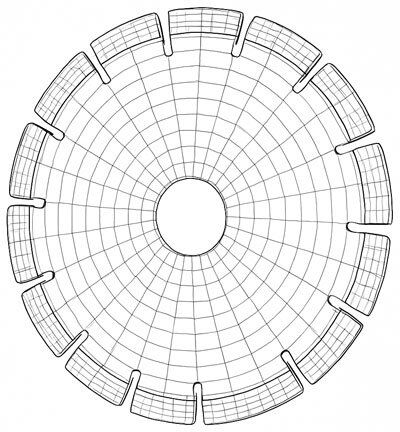
Steel Core – Structural Backbone
-
Flat, round metal disc
-
Supports the cutting segments
-
Keeps the blade stable and balanced
Segment – The Grinding Edge
-
Contains synthetic diamond crystals
-
Bonded with a metal powder matrix
-
Wears away to expose new, sharp diamonds
How Diamond Blades Are Built
Diamond blades consist of two major components that work together to deliver precise grinding performance:
-
Steel Core: The circular backbone of the blade, built from tempered metal to maintain shape and absorb stress during high-speed rotation.
-
Segment: The outer cutting edge where synthetic diamonds are embedded in a metal bond. As the segment wears down, new diamonds are exposed, maintaining cutting efficiency.
Blades vary in construction depending on application—ranging from light-duty dry cutting to industrial wet cutting using high-horsepower equipment. The type of segment attachment (brazed, sintered, or laser welded) plays a critical role in determining the blade’s durability and intended use.
Attachment Methods
Vacuum-brazed blades feature diamond grit fused directly to the core, making them ideal for cutting soft materials, dry cutting applications, and low-horsepower tools. They offer fast cutting but wear quickly.
Sintered blades are made by compressing diamond and metal powder under heat. They’re versatile, suitable for both dry and wet cutting with moderate durability.
Laser-welded blades offer the strongest bond. Designed for wet cutting with high-powered saws, they excel on hard materials and in deep cuts, delivering long-lasting performance in demanding applications.
💡 Pro Tip: Always match the attachment type with the material and machine power. Laser-welded blades are best for demanding tasks, while vacuum-brazed blades are more suited for light-duty work.

Diamond Characteristics
- Diamond segments are made with synthetic crystals, chosen and configured based on three key attributes: concentration, quality, and size. These factors directly impact blade performance, lifespan, and the type of material each blade can handle.
- Concentration refers to the amount of diamond present in the segment. Higher concentrations require more motor power but can cut faster and last longer, primarily when used with high-horsepower tools.
- Quality affects how well diamonds resist heat and maintain sharp edges. Premium synthetic diamonds remain effective longer, especially in demanding conditions such as cutting dense stone or concrete.
- Size is measured in mesh ranges. Coarse diamonds (e.g., 25/35 mesh) are better suited for soft materials, such as asphalt or soft brick. Finer diamonds (e.g., 50/60 mesh) are ideal for hard, brittle materials like quartz or porcelain. The finer the mesh, the more precise—but slower- the cut.
💡 Tip: The right combination of these three characteristics ensures optimal cutting efficiency and tool longevity, tailored to the job’s demands.

Bonding System & Wear Rate
- Bond = Metal powders
- Holds diamonds in place
- Wears to expose new diamonds
Soft vs. Hard Bonds
- Soft Bond: Fast wear → Best for hard, non-abrasive materials
- Hard Bond: Slow wear → Best for soft, abrasive materials
🔁 Rule: Soft bond for hard materials, hard bond for soft
How Diamond Blades Work
Diamond blades don’t slice—they grind. The exposed diamond crystals perform the cutting action on the blade’s segment edges. As the blade spins at high speed, these crystals wear down the material by friction, turning it into fine dust.
This grinding process is possible because the blade is made with a metal bond matrix that holds the diamond particles in place just long enough to be useful. As each diamond point wears, the bond gradually erodes, releasing the spent crystal and exposing a fresh, sharp one.
This creates a self-renewing cycle:
- Exposed diamonds grind the material.
- Diamonds wear out and fracture.
- Bond erodes to release worn diamonds.
- New diamonds become exposed.
This cycle continues throughout the segment’s life. Once the segment is fully worn and all diamonds are consumed, the blade stops cutting effectively, signaling it’s time for a replacement.
✅ Result: Consistent performance, minimal downtime, and smoother cuts across a wide range of materials.
Explore Diamond Blades by Category
Looking for the right blade for your next job? Explore our full range of diamond blades, categorized by application and material. Whether you need precision for porcelain or power for concrete, we’ve got you covered.


